
Why is there never a settled answer for drum tone?
“It depends on the genre and the source, so there is no right answer.” Read anything about mixing drums and you will run into that line almost every time.
And it is not wrong. Acoustic jazz and heavily edited modern metal ask for different things. How much low end the kick keeps. How hard the snare attack is pushed. Plenty does change with the style of the song and the material in front of you.
But that premise seems to get taken a little too far.
“Drum tone is something you build from nothing, fully custom, every time” — that idea has grown so loud that the part which does not depend on genre or source, the part that holds true across all of them, has been left out of the conversation entirely.
You should not have to agonise over it that often. There is room for a consistent starting point. That is what I kept thinking.
A guitar amp is not redesigned around the guitar you plug into it
Think about how guitar tone works.
Plugging in a Stratocaster does not retune the frequency response inside the amp for Strats. Plugging in a Les Paul does not rebuild its internal circuit for humbuckers.
Gain, bass, middle, treble — those get moved every time, certainly. But the fundamental character of the amp stays where it is. The frequency points do not shift. The compression behaviour does not change. And it still works. In guitar tone, this is completely unremarkable.
So why, the moment it is drums, does it turn into building EQ and compression back up from nothing, patchwork by patchwork, every single session?
Separate what can stay fixed from what has to stay adjustable
Drums and guitar are different instruments, of course. But as far as shaping tone goes, there should be some thinking they can share.
A kick has a broad direction that makes it work as a kick. A snare has one that makes it work as a snare. So do the toms, the cymbals, the room mics. And that broad framing does not get completely overturned because the situation changed. That is what I believe.
What actually matters is separating what can simply stay fixed from what has to be decided case by case.
Working engineers do not start from a blank page either. There is a compressor they reach for, EQ points they keep coming back to, an order they usually work in. The source goes through the familiar template first, and only what needs moving gets moved. That is a perfectly natural way to work.
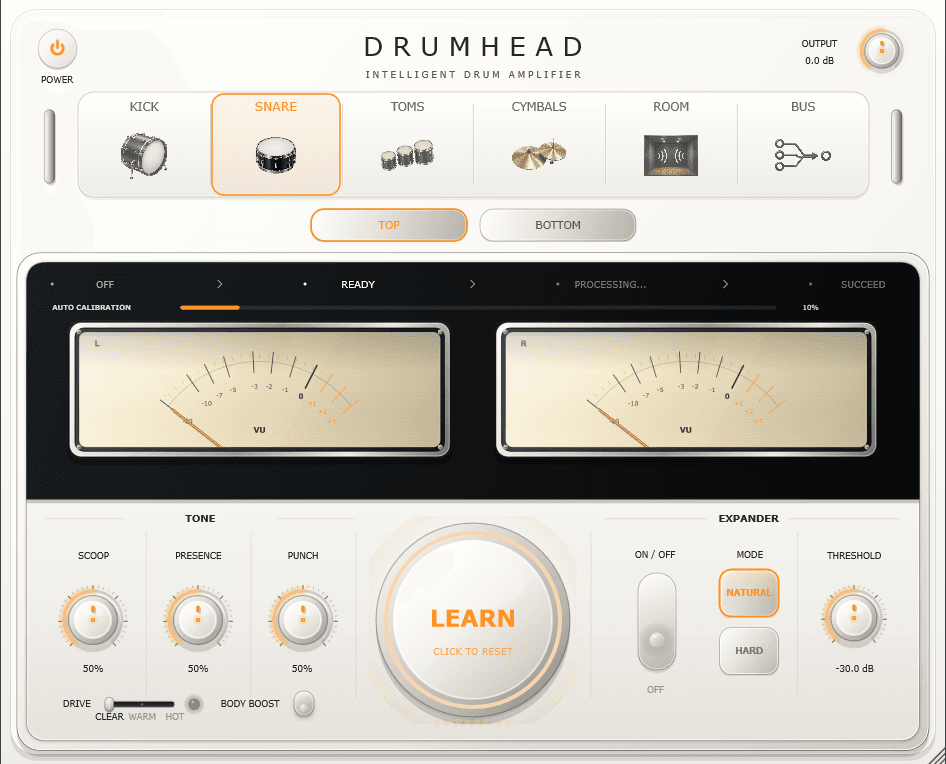
So why not make the template itself the plugin. That is where DRUMHEAD started. Insert it, pick the part, and the tone is decided — the way a guitar amp works. That is the whole concept.
To do that, DRUMHEAD splits drum tone three ways. What we fix in advance. What gets matched to your material automatically. And what you decide.
The basic processing stays fixed
The processing that gets a drum into shape is settled in advance, on our side. Kick as kick. Snare as snare. Each track already has a chain suited to it — filtering, compression, EQ and the rest — built and waiting.
Put bluntly, it is the part where “handling it roughly like this is going to be fine.” There is nothing here for you to design again.
Calibration that matches your material
There is one thing, though, that clearly does change with the source: input level.
With the exact same compressor settings, a snare arriving 10 dB louder produces a very different amount of gain reduction. At that point “keep the processing fixed” stops meaning anything.
So DRUMHEAD uses the LEARN button to read the incoming signal and match the level automatically, so the internal processing lands in the range it was designed for. Loud source or quiet, it never slams and never barely engages — the gain reduction stays where it should.
The character is yours, with only the controls you need
Less room. More attack. More punch. A little more air up top. A warmer feel.
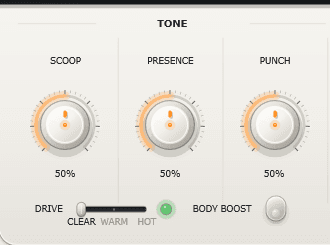
Those calls — what character do you want — are not for a machine to make. So that is all that was left on the panel.
The housekeeping stays fixed. Level differences are matched automatically. The character is yours. Those are the three roles DRUMHEAD divides the work into.
Which makes the whole workflow this short
- 1Insert it on the track and pick the part — kick, snare, toms, cymbals, room or bus
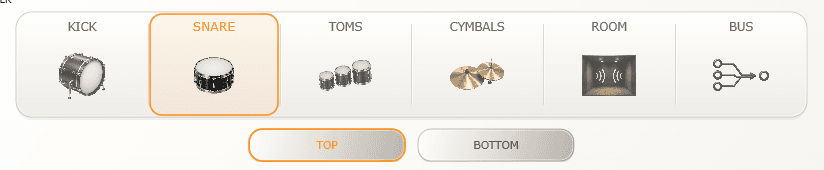
- 2Hit LEARN and play a representative hit

- 3Watch the level settle so the chain lands where it should

- 4Then shape it to your taste with a handful of knobs
None of drum tone has to be thought through from nothing. Rather than staying lost in the details, settle the broad direction first. Then use your ears on the parts that genuinely call for a musical decision.
Guitar tone gets to start from “let’s plug into this amp and see how gain and tone sit.” Drums are allowed to be approached just as loosely.
DRUMHEAD is a proposal for that way of working.